Fitness is often presented as something that happens inside a gym.
You see people lifting heavy weights, running on treadmills, completing intense workouts and chasing bigger numbers on their fitness trackers.
But there is another side of fitness that is becoming increasingly important: functional fitness.
Instead of focusing only on how much you can lift or how many calories you can burn, functional fitness focuses on helping your body perform everyday movements more comfortably and effectively.
Think about getting out of a chair, climbing stairs, carrying groceries, picking something up from the floor, reaching overhead or maintaining your balance.
These are all physical tasks.
Functional training uses exercises that can help develop the strength, mobility, balance and coordination needed for activities like these. Functional fitness is also included among the American College of Sports Medicine's top fitness trends for 2026.
The best part is that you do not need an expensive gym membership to get started.
What Is Functional Fitness?
Functional fitness is a style of exercise that focuses on movements and physical abilities that transfer to everyday activities or sport.
Rather than training a muscle only because it looks good, functional training often combines multiple muscles and movement patterns at the same time.
A squat is a simple example.
You use a similar movement when you sit down and stand back up from a chair.
A carrying exercise can prepare your body for holding shopping bags or moving objects around your home.
A step-up resembles the action of climbing stairs.
This does not mean traditional gym exercises are bad. Machines, isolation exercises and bodybuilding-style training can all have their place.
Functional fitness simply adds another question to your workout:
“What can this exercise help my body do?”
1. Squats for Stronger Legs
Squats are one of the easiest movements to include in a functional workout.
You perform a similar pattern every time you lower yourself toward a chair and stand back up.
If you are new to exercise, start with chair squats.
Stand in front of a sturdy chair with your feet around shoulder-width apart. Slowly bend your knees and hips, lower yourself toward the chair and then stand back up.
You do not have to sit completely down if that feels uncomfortable.
As you become stronger, you can progress to bodyweight squats and eventually add resistance if appropriate.
Beginner tip: Keep the movement controlled instead of trying to perform as many repetitions as possible. Good technique is more useful than rushing through a set.
2. Step-Ups for Everyday Strength
Stairs are part of everyday life for many people, which makes step-ups a useful functional exercise.
Using a stable, low step or platform, place one foot on top and carefully push through that leg to bring your body upward. Step back down and repeat on the other side.
Start with a low surface and hold onto something stable if you need additional support.
Step-ups can challenge your legs while also requiring balance and coordination.
As your fitness improves, you can gradually increase the height or add resistance if it is appropriate for you.
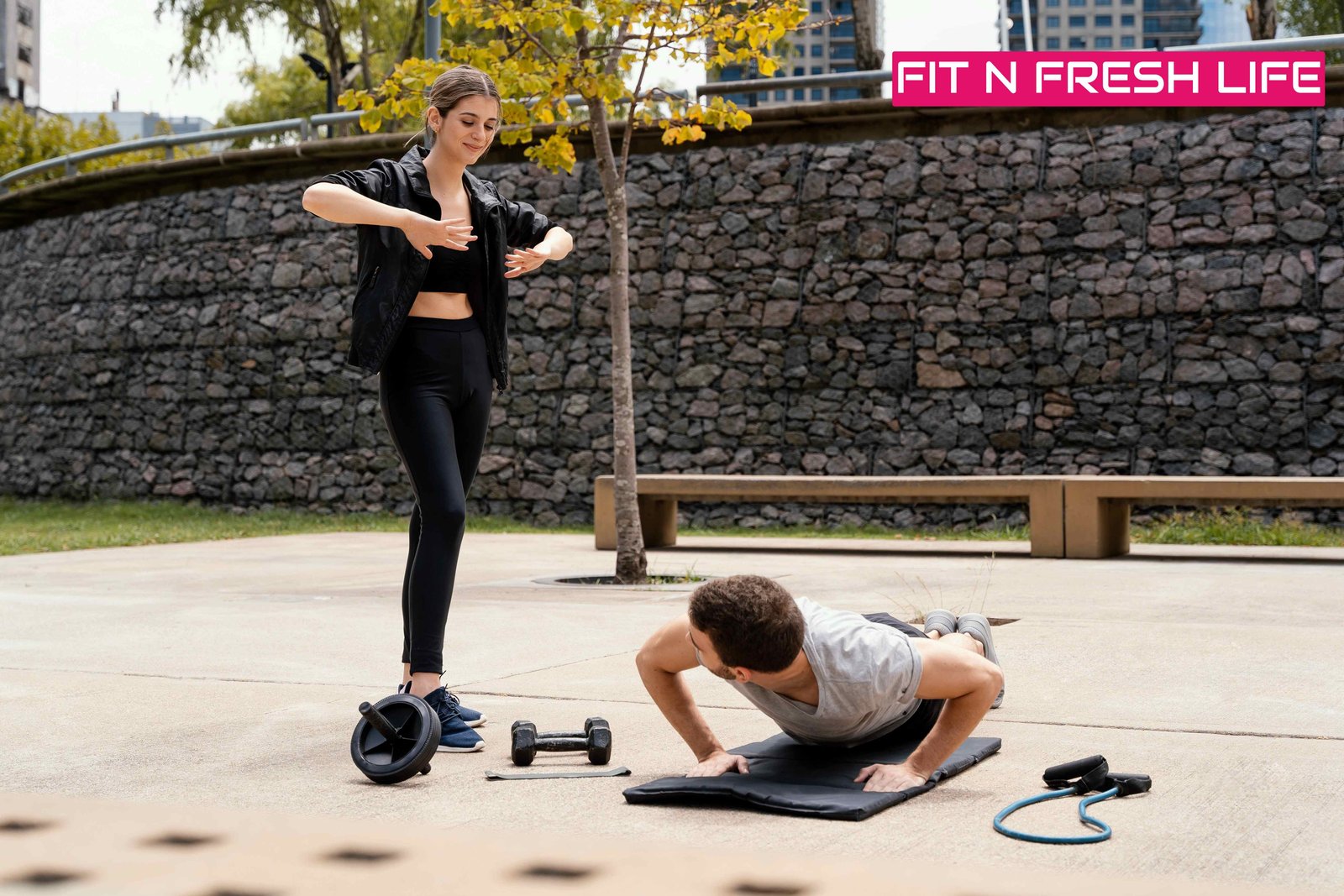
3. Push-Ups for Upper-Body Strength
You do not have to be able to perform a full push-up from the floor to benefit from the movement.
Beginners can start with wall push-ups.
Stand facing a wall, place your hands against it and slowly bend your elbows to bring your chest closer to the wall. Push yourself back to the starting position.
Once that becomes comfortable, you can progress to an incline push-up using a sturdy elevated surface and eventually work toward a floor push-up.
Push-ups train several muscles in your upper body and require your core to help stabilize your body.
4. Carry Something Instead of Only Lifting It
One of the simplest functional movements is carrying.
Think about carrying groceries from your car, moving a suitcase through an airport or holding a bag while walking.
That is why loaded carries can be useful in functional training.
If you have appropriate equipment and experience, you can carry dumbbells or other manageable weights while walking a short distance.
If you are completely new to strength training, start very light.
The objective is not to see how heavy an object you can carry. It is to practice maintaining good posture and control while moving.
5. Train Your Core for Stability
Core training is often associated with getting visible abdominal muscles.
But your core has another important job: helping stabilize your body while you move.
Simple exercises such as dead bugs, bird dogs and controlled planks can challenge your core without requiring hundreds of crunches.
For example, the bird dog involves starting on your hands and knees and slowly extending one arm and the opposite leg while keeping your torso controlled.
Move slowly.
Functional training is not about making an exercise look complicated. Control is more important than speed.
6. Don't Forget Pulling Movements
Many home workouts contain plenty of pushing exercises but very little pulling.
Pulling movements can help develop the muscles of your back and upper body.
If you have resistance bands, a band row can be a simple option.
Anchor the band securely, hold the handles and pull toward your body while keeping your shoulders controlled.
If you use resistance equipment, make sure it is designed for the exercise and properly secured.
You can also use gym machines or cable equipment if you prefer working out at a fitness center.
7. Add Balance Exercises
Strength is important, but fitness is not only about strength.
Balance and coordination also matter.
A simple starting exercise is standing on one foot near a sturdy surface that you can hold if needed.
Stand tall, lift one foot slightly off the floor and hold the position for a few seconds. Switch sides.
As your balance improves, you can gradually increase the duration.
Older adults in particular are encouraged to include balance activities alongside aerobic and muscle-strengthening activities.
You do not have to wait until you are older to practice balance, though.
It is a useful physical skill at almost any age.
8. Train Your Body to Move in Different Directions
Everyday movement does not happen only in a straight line.
You turn around. You reach sideways. You step over objects. You rotate to look behind you.
That is why a well-rounded fitness routine should include more than forward movement.
Simple lateral steps, controlled rotations and mobility exercises can help you become more comfortable moving in different directions.
Start slowly, especially with movements that involve rotation.
If a movement causes pain rather than normal muscular effort or mild stretching, stop and reassess your technique.
9. Combine Strength With Cardio
Functional fitness does not mean ignoring cardiovascular exercise.
Your heart and lungs also need training.
Walking, cycling, swimming, jogging, dancing and many other activities can provide aerobic exercise.
Current CDC guidance recommends that adults aim for at least 150 minutes of moderate-intensity aerobic activity each week, or an equivalent combination of moderate and vigorous activity, along with muscle-strengthening activity on at least two days per week.
You do not have to complete all of that in one session.
Shorter periods of activity can be spread throughout the week.
For someone who currently does very little exercise, simply becoming more active is a useful first step.
10. Mobility Deserves a Place in Your Routine
Strength gets a lot of attention in fitness, but being able to move comfortably through an appropriate range of motion matters too.
Spend a few minutes moving your joints before or after exercise.
Gentle shoulder circles, controlled hip movements, ankle movements and other comfortable mobility exercises can be included in a warm-up or cool-down.
You do not need to spend an hour stretching every day.
Think of mobility as something you maintain gradually rather than a performance you need to perfect.
Functional Fitness Is Not Just for Older Adults
Functional fitness is sometimes marketed mainly toward older people, but the concept is useful for everyone.
A younger person can benefit from stronger legs, better balance, a stronger core and improved movement control.
An athlete can use functional exercises to complement sport-specific training.
A busy office worker can use them to build strength without spending hours in a gym.
And someone returning to exercise after a long break can use simple movements to rebuild confidence.
The exercises may change depending on the person, but the basic idea stays the same: build physical abilities that have a purpose.
A Simple Functional Workout for Beginners
If you are new to exercise, you can start with a short routine instead of trying to complete a complicated workout.
Example beginner routine:
- Chair squats — 8 to 12 repetitions
- Wall push-ups — 8 to 12 repetitions
- Step-ups — 6 to 10 repetitions per side
- Bird dogs — 6 to 10 repetitions per side
- Light carrying exercise — 20 to 30 seconds
- Supported single-leg balance — 10 to 20 seconds per side
Rest when you need to. Start with one or two rounds and focus on controlled movement.
This is only an example, not a requirement.
Your starting point should depend on your current fitness level, experience, available equipment and any health considerations you may have.
How Often Should You Do Functional Training?
You do not need to perform a functional workout every day.
For many beginners, two strength-focused sessions per week can be a reasonable starting point, while other days can include walking, cycling or another enjoyable form of aerobic activity.
The CDC recommends muscle-strengthening activity on at least two days per week for adults, alongside aerobic activity.
Give your body time to recover, especially when you are introducing exercises it is not used to.
If you feel extremely sore after every workout, that may be a sign that you are doing too much too soon.
Progress Doesn't Always Mean Adding More Weight
Fitness progress can happen in several ways.
You might perform more repetitions.
You might use slightly more resistance.
You might improve your balance.
You might perform the same exercise with better control.
You might recover faster between sets.
Or you might simply find everyday activities easier.
That last one is particularly important in functional fitness.
If climbing stairs feels easier than it did a few months ago, carrying groceries is more comfortable or getting up from the floor feels less difficult, those are meaningful signs of progress.
Don't Turn Every Workout Into a Competition
Social media can make fitness look like a constant competition.
Someone is always lifting heavier, running faster, doing more repetitions or completing a more difficult exercise.
That does not mean you need to copy them.
A workout should match your current ability.
Functional fitness is about building useful physical capacity, not proving that you can perform the most impressive exercise in the gym.
Start where you are and progress gradually.
What If You Have Been Inactive for a Long Time?
If you have not exercised for years, do not feel that you need to make up for lost time.
Start with walking and simple movements.
A few minutes of activity can be a better starting point than an intense workout that leaves you exhausted and discouraged.
Current CDC guidance emphasizes that some physical activity is better than none, and activity can be built up gradually.
If you have a chronic health condition, disability or other concerns about starting exercise, speak with a healthcare professional about what types and amounts of activity are appropriate for you.
The Bigger Goal of Functional Fitness
The real value of functional fitness is that it changes the way you think about exercise.
Instead of asking only, “How many calories did I burn?” you can also ask:
“Am I getting stronger?”
“Can I move more comfortably?”
“Is my balance improving?”
“Can I do everyday tasks more easily?”
Those questions can make fitness feel much more connected to real life.
Final Thoughts
You do not need a complicated workout program to become fitter.
Start by teaching your body to squat, push, pull, carry, step, balance and move with control. Add regular walking or another form of cardio, give yourself enough recovery time and gradually make your workouts more challenging as your ability improves.
Functional fitness is not about making exercise look impressive.
It is about building a body that can handle everyday life.
Train for the life you want to live—not just the numbers you want to see on a fitness tracker.
Disclaimer: This article is for general informational and educational purposes only and is not medical advice. Exercise needs vary from person to person. If you have a health condition, injury, disability, have been inactive for a long period, or are unsure which exercises are appropriate for you, speak with a qualified healthcare professional before beginning a new exercise program. Stop exercising and seek appropriate medical advice if you experience concerning symptoms such as chest pain, severe shortness of breath, dizziness or fainting.