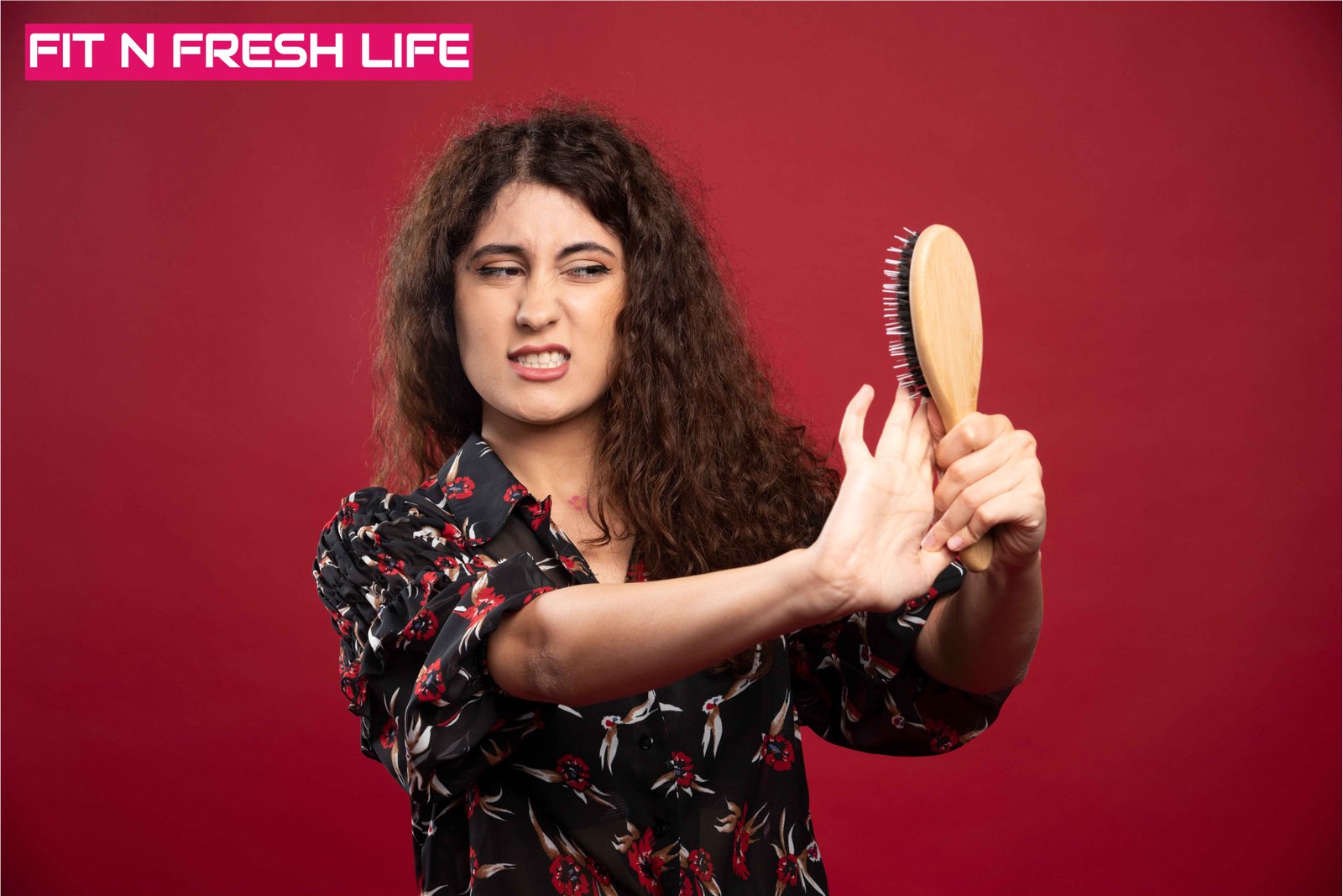
Most people use a hairbrush without ever really looking at what is left behind.
You brush your hair, remove the loose strands, put the brush away and move on with your day.
But every now and then, it can be useful to stop and take a closer look.
The hair in your brush can sometimes give you clues about what is happening with your hair routine. You may notice more loose strands than usual, tiny broken pieces, excessive tangling, product buildup or even changes in the condition of your scalp.
That does not mean your hairbrush can diagnose a health problem. It cannot.
But paying attention to patterns can help you recognize when your routine may need a little adjustment — and when something deserves professional attention.
First, Don't Panic About a Few Loose Hairs
Finding hair in your brush is completely normal.
Hair naturally goes through growth and shedding cycles, so loose strands can end up on your clothes, pillow, shower drain and brush.
How much you notice can also depend on how often you brush your hair.
If you normally brush your hair several times a day, you may see fewer strands each time. If you only brush once a day, or your hair is curly or textured and you do not brush it frequently, several days' worth of naturally shed hairs may come out together.
So the number of hairs you see in one brushing session does not automatically tell you whether something is wrong.
Patterns matter more than one isolated brushing.
Look at the Difference Between Shedding and Breakage
This is one of the most useful things you can learn to notice.
A naturally shed hair has usually completed its growth cycle and comes away from the scalp. A broken hair is different — it has snapped somewhere along the length.
Broken pieces are often shorter than the rest of your hair and may appear in your brush alongside full-length strands.
If you regularly notice lots of shorter pieces, it may be worth looking at how you treat your hair.
Frequent heat styling, tight hairstyles, chemical treatments, aggressive brushing and rough handling can all contribute to hair damage and breakage.
This is particularly important if your hair feels rough, tangles easily or seems to be getting shorter around the ends even though you are trying to grow it.
What Do the Hairs in Your Brush Actually Look Like?
You do not need to inspect every strand under a microscope.
Just occasionally notice what you are seeing.
Are most strands long and similar to the length of your hair? That is more consistent with normal shedding.
Are there lots of very short pieces? That may suggest breakage.
Are the ends extremely frayed or split? Your hair may be experiencing more mechanical or heat damage than your routine can handle.
Do the strands seem to be coming out in noticeably larger amounts than usual? That is a pattern worth paying attention to, particularly if it continues.
Your brush is not giving you a diagnosis. It is simply another place where changes in your hair may become noticeable.
Your Hairbrush Can Also Tell You About Your Scalp
Look beyond the hair itself.
Is there a lot of white or flaky material around the brush?
Does the brush have oily residue?
Are there larger pieces of buildup stuck between the bristles?
Some residue can simply be a mixture of natural scalp oils, dead skin cells, styling products and hair-care products.
But persistent flaking, itching, redness or irritation can be a sign that your scalp needs more attention.
Dandruff and other scalp conditions can have different causes, so constantly scratching or aggressively scrubbing your scalp is not necessarily the answer.
If scalp symptoms continue despite gentle care, a dermatologist can help determine what is actually happening.
A Dirty Brush Can Put Product Back Into Clean Hair
There is another practical reason to pay attention to your brush.
Your brush collects whatever comes into contact with it.
That can include hair oil, styling products, dust, loose skin cells and shed hair.
If you keep using the same brush without cleaning it, some of that buildup can be transferred back onto freshly washed hair.
That does not mean your brush needs to be disinfected every day.
But removing trapped hair regularly and cleaning the brush according to the manufacturer's instructions can help keep it in better condition.
The Way You Brush Matters
Sometimes the problem is not your hairbrush. It is how you use it.
Brushing aggressively through a large knot can put unnecessary tension on the hair.
Instead of repeatedly pulling from the roots through a tangled section, work through knots gradually.
For longer or easily tangled hair, you may find it easier to start closer to the ends and work upward in sections.
The exact technique can depend on your hair type and texture.
The basic idea is simple: do not treat tangles like something you have to fight.
Wet Hair Needs a Little More Care
Wet hair can be more vulnerable to stretching and breakage, so rough brushing immediately after washing may not be ideal for everyone.
How you handle wet hair should depend on its texture and condition.
Some people with curly or textured hair may deliberately detangle while their hair is wet and conditioned because that works better for their hair type.
Others may prefer to let their hair partially dry before gently detangling.
There is no single brushing rule that works perfectly for every head of hair.
What matters is minimizing unnecessary pulling and using a technique that works with your hair rather than against it.
Are You Seeing More Hair Than Usual?
This is where context becomes important.
Instead of comparing your brush with someone else's, compare it with your own normal pattern.
Has the amount of hair you see changed noticeably?
Does your ponytail feel thinner?
Are you noticing more hair on your pillow or in the shower?
Can you see more scalp than you normally could?
These changes can have many possible explanations, including temporary shedding after certain life events, changes in health, nutritional issues, hormonal changes, medications and hereditary hair-loss patterns.
It is not possible to determine the cause simply by looking at your brush.
If increased shedding continues or you are concerned about noticeable thinning, speaking with a healthcare professional or dermatologist is a better approach than trying random hair-growth products.
Don't Count Every Strand
It can be tempting to turn hair care into a daily counting exercise.
Try not to.
Counting individual hairs every time you brush can create unnecessary anxiety, and the number can naturally vary depending on when and how you wash and brush your hair.
Instead, look for noticeable changes over time.
A general impression such as “I'm seeing considerably more shedding than I used to” can be more useful than trying to determine whether you lost exactly 50 or 100 strands.
Your Hairbrush Can Reveal Too Much Product
Sometimes what looks like a hair problem is actually a product problem.
If your brush feels sticky or has a visible coating, think about what you have been putting in your hair.
Leave-in conditioners, oils, gels, creams, sprays and styling products can accumulate on both hair and brushes.
That does not mean these products are bad.
It simply means that using several products repeatedly without an appropriate cleansing routine can leave buildup behind.
If your hair suddenly feels heavy, greasy, dull or difficult to style, look at your entire routine rather than immediately buying another product.
Pay Attention to How Your Hair Feels After Brushing
The brush itself is only part of the story.
Think about how your hair feels afterward.
Does it feel smooth and flexible?
Does it become frizzy immediately?
Does it feel unusually dry?
Does brushing create lots of static?
Does your hair tangle again almost immediately?
These observations can help you understand what your hair may need.
For example, hair that repeatedly feels dry and rough may benefit from reducing excessive heat and harsh handling. Hair that becomes greasy very quickly may require a different cleansing approach.
There is no universal routine because hair texture, scalp type, environment and styling habits all differ.
Be Careful With Tight Hairstyles
If you consistently see shorter broken hairs around your hairline, do not automatically blame your brush.
Think about what happens to your hair throughout the day.
Very tight ponytails, buns, braids or extensions can place repeated tension on the hair and scalp.
Wearing a hairstyle once is unlikely to tell you much. The concern is repeated tension over time.
If a hairstyle causes pain, headaches or significant pulling around your hairline, that is a useful signal to change it.
Comfort is not something you should have to sacrifice for a hairstyle.
Heat Styling Can Show Up in Your Brush
Hair dryers, straighteners and curling tools can be useful styling tools, but frequent high heat can contribute to damage.
If you are seeing more breakage, especially around the ends, think about how often you use heat and how high the temperature is.
You do not necessarily need to stop using styling tools completely.
Using lower temperatures when practical, avoiding unnecessary repeated passes and following appropriate product instructions can help reduce excessive heat exposure.
Give your hair occasional days where you simply wash, condition and let it dry naturally if that works for your hair.
Your Brush Choice Matters Too
There is no magical brush that makes every person's hair healthier.
But your brush should suit your hair type and the way you use it.
If the bristles repeatedly snag your hair, pull hard through knots or cause discomfort on your scalp, consider trying a different design.
For some people, a wide-tooth comb works better for detangling. Others prefer a particular brush designed for their hair texture.
The best tool is usually the one that lets you detangle without excessive pulling.
When You Should Stop Blaming Your Hairbrush
Sometimes a noticeable hair change has nothing to do with brushing.
If you are experiencing persistent or significant hair loss, bald patches, scalp pain, intense itching, sores, redness or other unusual changes, it is worth getting professional advice.
The American Academy of Dermatology recommends seeing a dermatologist when you are concerned about hair loss because there are many possible causes and identifying the cause is important for choosing appropriate treatment.
Trying multiple supplements or expensive hair products without knowing what is causing the change may simply waste money.
A Simple Hairbrush Check Before Your Next Wash
Next time you brush your hair, take thirty seconds to notice a few things.
- Are you seeing roughly the same amount of shedding as usual?
- Are there many short broken pieces?
- Do the ends look unusually frayed?
- Is there visible product buildup on the brush?
- Does your scalp look or feel irritated?
- Are you brushing through tangles gently or pulling hard?
- Have you recently changed your shampoo, styling products or routine?
- Have you started using more heat or tighter hairstyles?
You do not need to turn this into a daily inspection.
Checking occasionally is enough to become more aware of changes.
A Better Hair Routine May Be Simpler Than You Think
Healthy-looking hair does not necessarily require a shelf full of products.
A basic routine can include a suitable cleanser, conditioner when appropriate, gentle detangling and reasonable protection from excessive heat and tension.
Keep your brush clean. Avoid aggressively pulling through knots. Give your hair a break from styles that create constant tension.
And remember that the appearance of your hair is influenced by more than the products you apply to it.
Hair growth and shedding are affected by the natural hair cycle as well as factors such as genetics, hormones, health and nutrition.
That is why buying another bottle of “miracle” hair serum is not always the answer.
The Bottom Line
Your hairbrush cannot tell you everything about your health or your hair.
But it can give you useful clues about your everyday routine.
Look for patterns rather than obsessing over individual strands. Learn to recognize the difference between normal shedding and obvious breakage. Pay attention to excessive tangling, buildup, scalp irritation and changes that continue over time.
Most importantly, do not panic because you find hair in your brush.
Some shedding is a normal part of having hair.
The goal is simply to become more aware of what is normal for you so that a genuine change is easier to notice.
Sometimes better hair care starts with simply paying closer attention to what your brush is showing you.
Beauty Disclaimer: This article is for general beauty and educational purposes only. Hair shedding, breakage and scalp changes can have many different causes. If you experience sudden, significant or persistent hair loss, scalp symptoms or other concerning changes, consult a qualified healthcare professional or dermatologist.